Picture of People in Great Depresion
Having survived a bout with polio as a child and endured the painful separation of her parents at age 12, Dorothea Lange (born Dorothea Nutzhorn) struck out on her own in 1919. She left her native New Jersey for an adventure around the world but only made it as far as California, where she settled and opened a photography studio. She was skilled behind the camera and in her dealings with clients. It was this ability to connect with people that enabled her to successfully leap from portrait to documentary photographer in the 1930s.
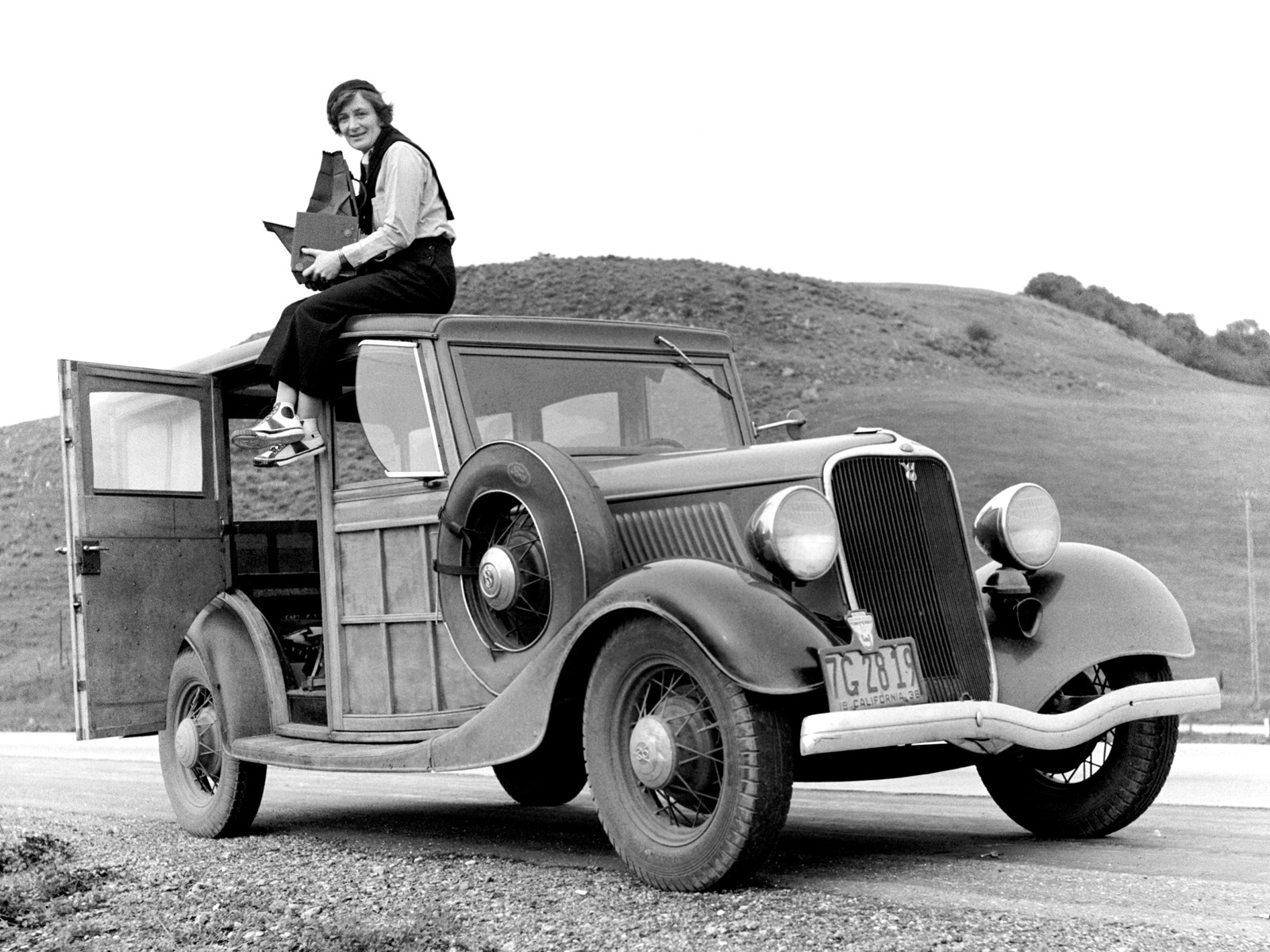
"Dorothea Lange" Photo by Rondal Partridge. 1936, Library of Congress
In that decade, Lange divorced her first husband, artist Maynard Dixon, with whom she had two sons, and married Paul Taylor, an economist who became an advocate for farm workers during the Depression. Taylor secured a job with one of Franklin D. Roosevelt's New Deal programs, the Resettlement Administration, later known as Farm Security Administration (FSA). Lange accompanied him in the field and soon received a job of her own, as photographer for the FSA. The images she made from the mid-1930s to 1940—including the famousMigrant Mother—are now considered icons of American culture.
After the attack on Peal Harbor, Lange documented the government-mandated evacuation of Japanese Americans to internment camps during World War II. She continued to represent the American struggle in her pictures until her death in 1965.White Angel Breadline—her first documentary image—is typical of Lange's work, in that it makes us see the big picture—not just the sad state of a man with a tin cup, but the desperate state of a nation.
The 1930s
The stock market crash of October 1929 set off a series of catastrophic events that plunged the country into an economic collapse known as the Great Depression. As the 1930s began, banks failed, businesses folded, and workers were laid off in droves. To make matters worse, the country suffered one of the worst droughts in history. Farmers from Virginia to Oklahoma saw their crops wither and die. By the middle of the decade, many abandoned their stricken land and headed west to California, where they worked as migrant laborers in an effort to feed their families.
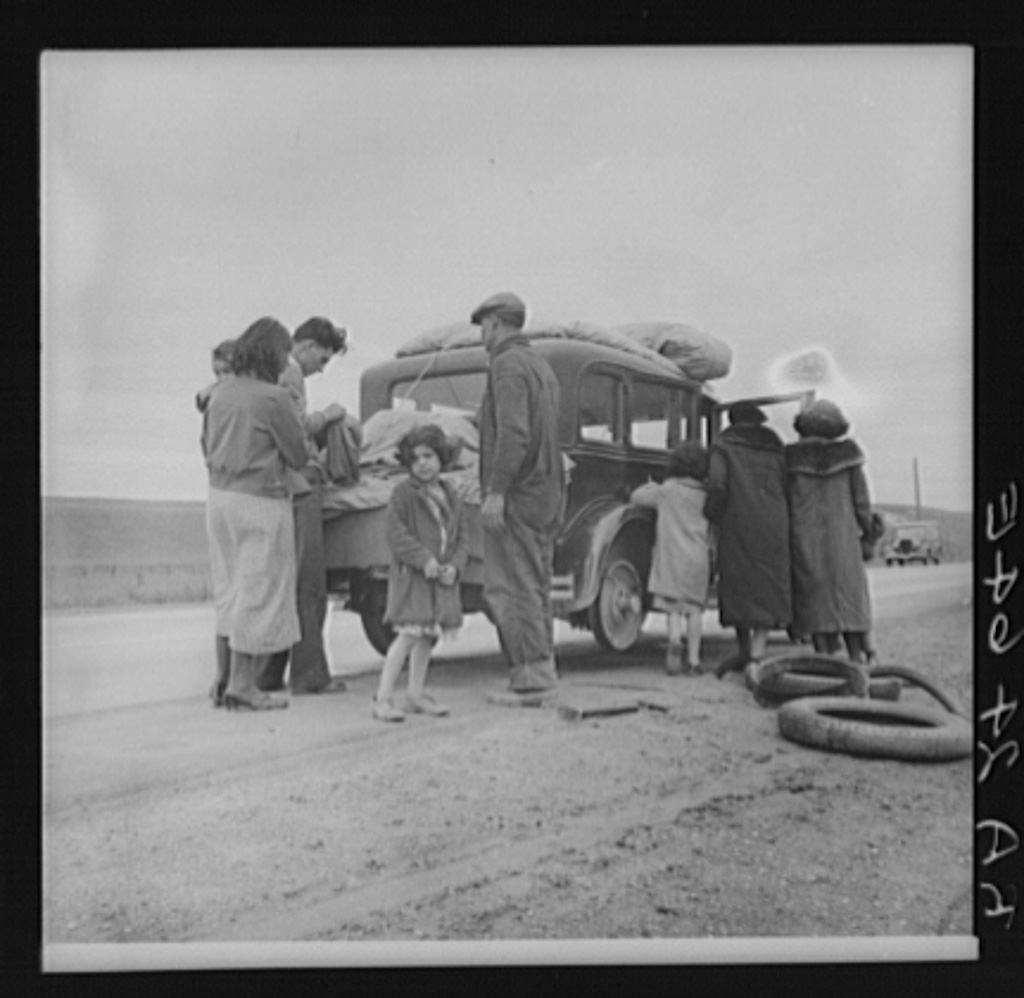 Dorothea Lange.Migrants, family of Mexicans, on road with tire trouble. Looking for work in the peas. California, February, 1936. Library of Congress.
Franklin Delano Roosevelt, who soundly beat Herbert Hoover in the presidential race of 1932, promised the country a "New Deal." He developed government programs such as the Civilian Conservation Corps and the Public Works Administration, which put people back to work and spurred growth. With the outbreak of World War II in 1941, the Great Depression became a bitter memory and the war effort took center stage.
Ironically, had the Depression not occurred, Dorothea Lange might never have become a noted photographer. Like the songs of Woody Guthrie and the writings of John Steinbeck, her images from that time captured the struggles of ordinary people who encountered extraordinary hardship and brought their plight to the attention of the American public.
White Angel Breadline
Dorothea Lange was a hard-working mother of two boys in 1932, the year she took the now-famous photographWhite Angel Breadline. Her successful business as a portrait photographer of San Francisco's wealthy families was feeling the pinch of America's deepening economic crisis. Her unsteady marriage to artist Maynard Dixon grew even rockier as galleries closed and the demand for his paintings dried up. Lange and Dixon agreed to separate, and with her new freedom came a gradual transition: She decided to use her camera not only to capture the likenesses of her subjects, but also to tell their stories.
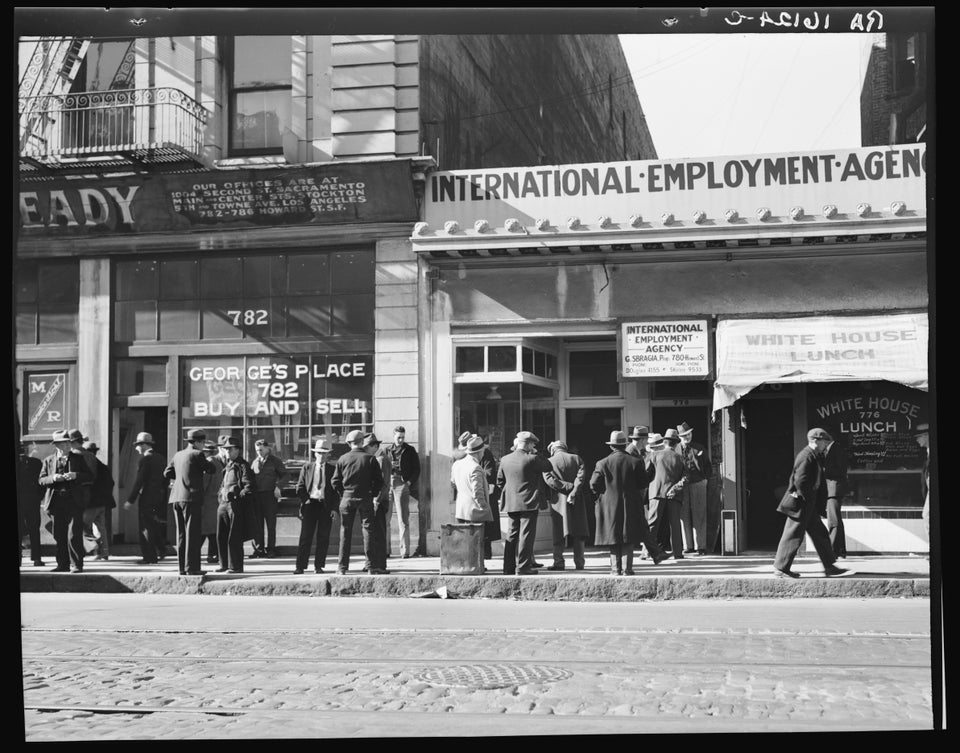 Dorothea Lange.Employment Agency, San Francisco. 1937
Taking her brother Martin along for support, Lange explored the streets of San Francisco's Mission District, which were lined with the homeless, hungry, and unemployed. She was concerned that she would anger her subjects by invading their privacy. She was worried that her large camera would frighten them away, that her process would be too slow, and that she would be accused of violating their dignity. But no one seemed aware of her. Not even the man with the tin cup, who faced away from the others on the White Angel Breadline. Hunched over the railing with his hat shielding his haggard face, he seemed lost. Lange was a newcomer to street photography but not to seizing the moment: "… I saw something, and I encompassed it, and I had it."
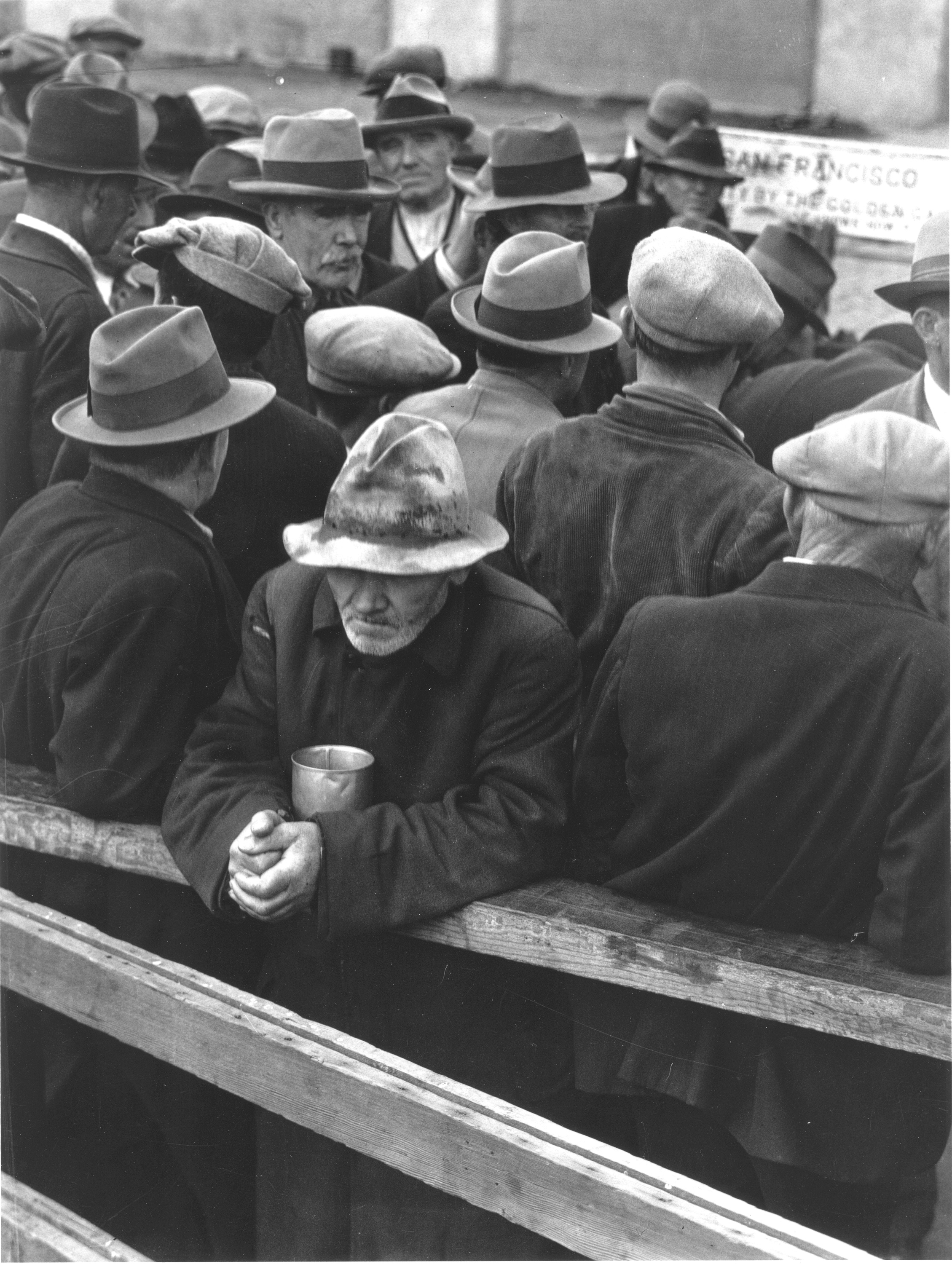 Dorothea Lange.White Angel Breadline, San Francisco, 1932. Gelatin silver print.
Collection of the Oakland Museum of California. Gift of Paul S. Taylor.
What Lange "had" was a disturbing but beautiful image that would come to represent the face of the Great Depression: The weariness indicated by the man's posture, the emptiness of his cup, his individuality obscured by the low brim of his hat, and his isolation from others on the breadline, all adding up to a poignant yet respectful portrait of hopelessness and despair.
"I had made some photographs of the state [of] people, in an area of San Francisco which revealed how deep the depression was. It was at that time beginning to cut very deep. This is a long process. It doesn't happen overnight. Life, for people, begins to crumble on the edges; they don't realize it…."
—Dorothea Lange, interview, 1964
The Real White Angel
There was a real "White Angel" behind the breadline that served the needy men photographed by Dorothea Lange. She was a widow named Lois Jordan. Mrs. Jordan, who gave herself the name White Angel, established a soup kitchen during the Great Depression to feed those who were unemployed and destitute. Relying solely on donations, she managed to supply meals to more than one million men over a three-year period.
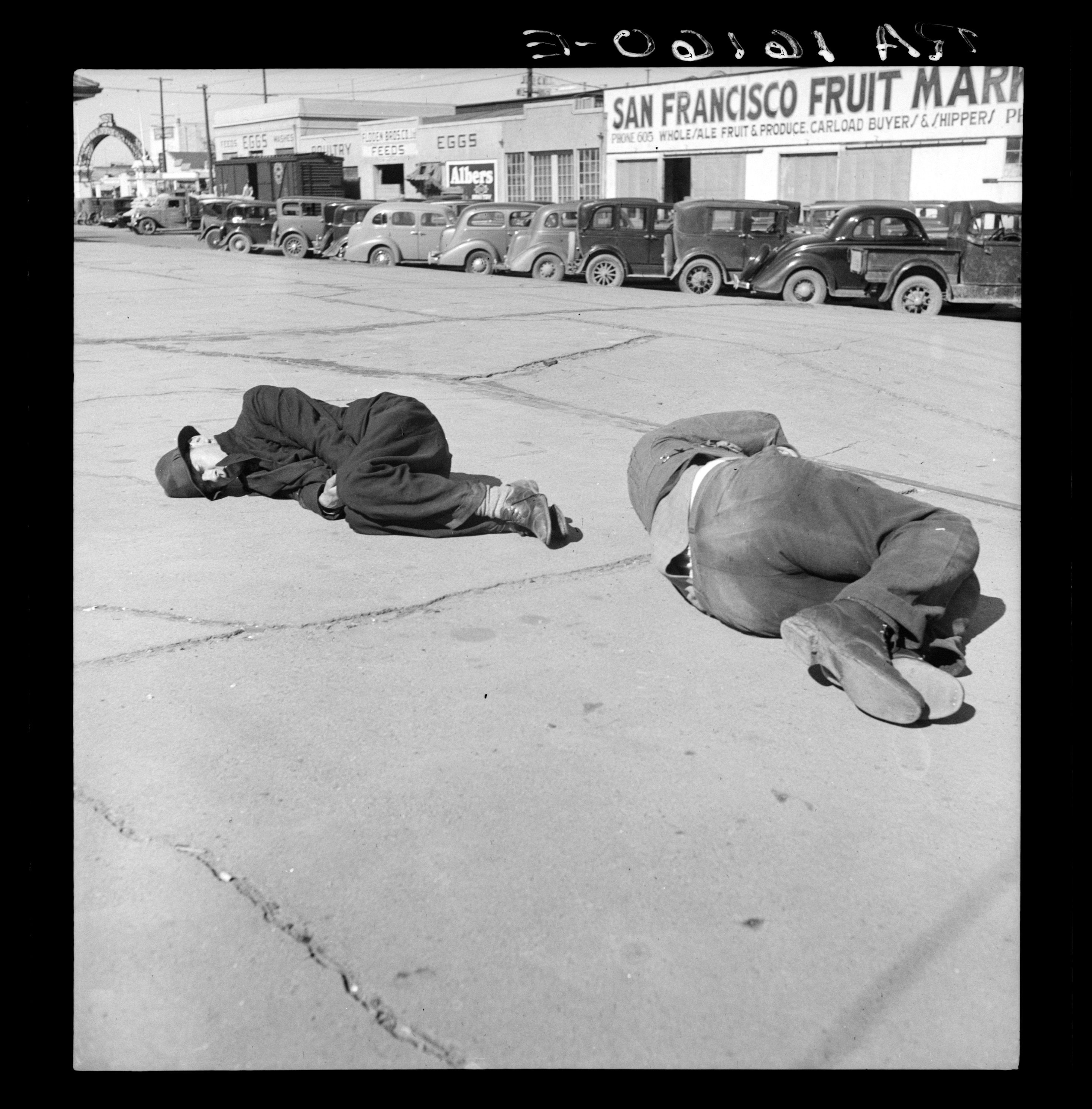 Dorothea Lange,Scene along Skid Row, Howard Street,
San Francisco, 1937. Gelatin silver print. Library of Congress.
Jordan's soup kitchen occupied a junk-filled lot in San Francisco located on the Embarcadero near Filbert Street. This area was known as the White Angel Jungle. The Jungle was not far from Lange's studio. As she began to change direction from portrait to documentary photography, Lange focused her lens on the poignant scenes just beyond her window.White Angel Breadline is the result of her first day's work to document Depression-era San Francisco. Decades later, Lange recalled:
"[White Angel Breadline] is my most famed photograph. I made that on the first day I ever went out in an area where people said, 'Oh, don't go there.' It was the first day that I ever made a photograph on the street."
Dorothea Lange's Documentary Photographs
Hear Dorothea Lange discuss her photographs and the difficulty of leading a visual life.

-
Writer
Amy Pastan
-
Editor
Lisa Resnick
-
Producer
Kenny Neal
-
Updated
November 4, 2019
Related Resources
America
Discover the multicultural heritage and history of America through explorations of immigrant life, the lives of legendary pioneers like Lewis and Clark, the modern political system, and significant works of American music, including our National Anthem.
- United States
Media Arts
Audio, video, animation, photography, and technology. From Depression-era images that captured the attention of a nation, to student-produced videos on local artists, to how to make your own blood and guts special effects, explore the ever-changing world of media arts.
- Media Arts
Brother Can You Spare a Dime?
Humbled by the Great Depression, this song gave voice to Americans' fears and feelings of loss
- Music
- History
- United States
Dorothea Lange + Migrant Mother
Photographer Dorothea Lange, whose picture Migrant Mother is one of the most famous photographs of the 20th century. See how Lange used her camera to tell the story of Depression-era Americans
- Media Arts
- History
- United States
- Women in the Arts
Women in the Arts
From providing historical inspiration to preserving cultural traditions to pushing the boundaries of creativity, explore the contributions women have made (and continue to make) to the arts.
- Women in the Arts
What Makes a Portrait "Great"?
What makes a great portrait in the digital—or any—age? By looking at the works of Richard Avedon and Andy Warhol we learn that it's not enough to create just another pretty face.
- Visual Arts
- Drawing & Painting
- Photography
John Steinbeck + The Grapes of Wrath
A collection of suggested lessons and activities aimed at helping students build a framework, from various perspectives of the 1930s, in which to embed a close study of Steinbeck's The Grapes of Wrath
- Literary Arts
- History
- United States
Kennedy Center Education Digital Learning
Eric Friedman
Director, Digital Learning
Kenny Neal
Manager, Digital Education Resources
Tiffany A. Bryant
Assistant Manager, Audience Enrichment
Joanna McKee
Program Coordinator, Digital Learning
JoDee Scissors
Content Specialist, Digital Learning
Connect with us!


Generous support for educational programs at the Kennedy Center is provided by the U.S. Department of Education.
Gifts and grants to educational programs at the Kennedy Center are provided by A. James & Alice B. Clark Foundation; Annenberg Foundation; the Andrew W. Mellon Foundation; Bank of America; Bender Foundation, Inc.; Carter and Melissa Cafritz Trust; Carnegie Corporation of New York; DC Commission on the Arts and Humanities; Estée Lauder; Exelon; Flocabulary; Harman Family Foundation; The Hearst Foundations; the Herb Alpert Foundation; the Howard and Geraldine Polinger Family Foundation; William R. Kenan, Jr. Charitable Trust; the Kimsey Endowment; The King-White Family Foundation and Dr. J. Douglas White; Laird Norton Family Foundation; Little Kids Rock; Lois and Richard England Family Foundation; Dr. Gary Mather and Ms. Christina Co Mather; Dr. Gerald and Paula McNichols Foundation; The Morningstar Foundation; The Morris and Gwendolyn Cafritz Foundation;
Music Theatre International; Myra and Leura Younker Endowment Fund; the National Endowment for the Arts; Newman's Own Foundation; Nordstrom; Park Foundation, Inc.; Paul M. Angell Family Foundation; The Irene Pollin Audience Development and Community Engagement Initiatives; Prince Charitable Trusts; Soundtrap; The Harold and Mimi Steinberg Charitable Trust; Rosemary Kennedy Education Fund; The Embassy of the United Arab Emirates; UnitedHealth Group; The Victory Foundation; The Volgenau Foundation; Volkswagen Group of America; Dennis & Phyllis Washington; and Wells Fargo. Additional support is provided by the National Committee for the Performing Arts.
The content of these programs may have been developed under a grant from the U.S. Department of Education but does not necessarily represent the policy of the U.S. Department of Education. You should not assume endorsement by the federal government.
Picture of People in Great Depresion
Source: https://www.kennedy-center.org/education/resources-for-educators/classroom-resources/media-and-interactives/media/media-arts/dorothea-lange-white-angel-breadline/
0 Response to "Picture of People in Great Depresion"
Post a Comment